Reading Chicago Ward 3's Three Numbers: Permits, 311 and Code Violations, and What None of Them Says About Your Block
A plain-language guide to the three figures on Civic Worth's Chicago Ward 3 page: which is permits, which is 311, which is code violations, how to read ranks, and how to cite them correctly in year-end reporting and grants.
Open the Chicago Ward 3 page and three numbers sit side by side under "Ward 3 by the numbers." Here they are, as of Nov 21, 2026:
- Development pulse (building permits): 18.0 permits per 1,000 parcels.
- 311 median days to close (within 30 days): 1.0 days median days to close, for requests closed within 30 days.
- Code violations & blight pressure: 51.4 building-code violations per 1,000 parcels.
They look alike at a glance. They are not. If you drop the wrong one into a year-end story or a grant narrative, the sentence will be confidently wrong, which is the worst kind of wrong to footnote.
These figures will move. The data behind the page is subject to change at any time, so treat the numbers above as a snapshot, and reopen the page on the day you file.
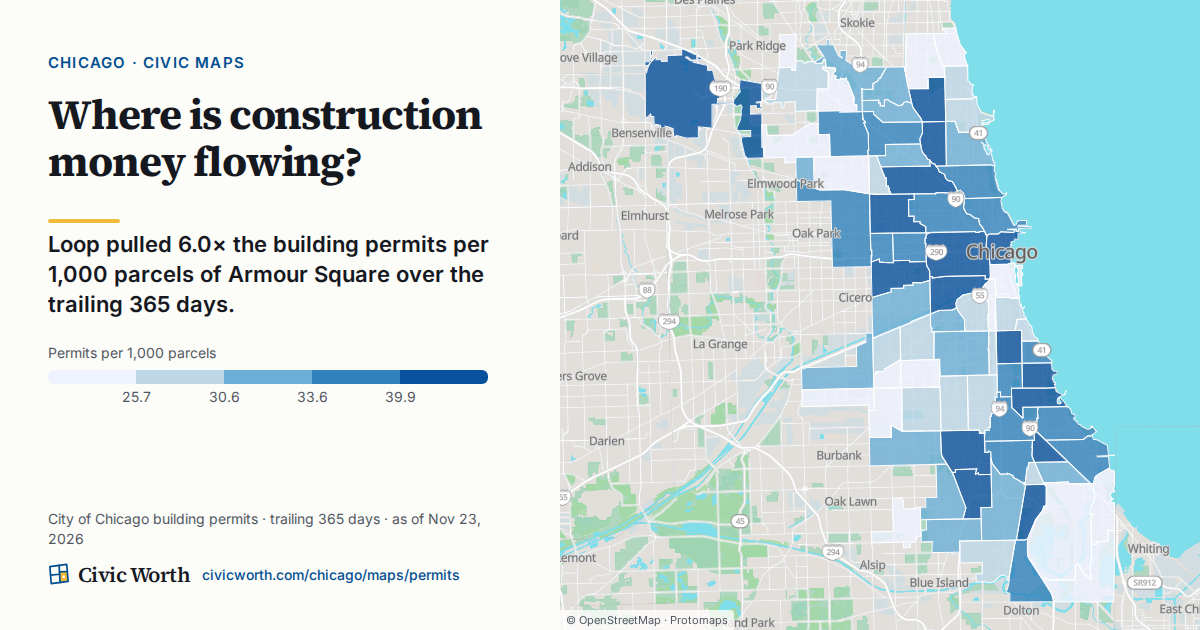
One of the three, the permit rate, has a map of its own: the Development pulse (building permits) map. We come back to it below.
Tell the three numbers apart by their units
The unit is the fastest way to sort them. Two are rates per 1,000 parcels. One is a median in days. If a figure is in days, it is the 311 one.
A parcel, for the record, is a piece of land with its own county parcel number. In Cook County that number is a Property Index Number.
Permits and code violations: rates per 1,000 parcels
The permit figure and the code-violation figure are both stated per 1,000 parcels, which puts wards of different sizes on the same footing. The two rates share a denominator but not a numerator: one counts permits, the other counts building-code violations.
311: a median, and only for requests that closed
The 311 figure counts only requests closed within 30 days. A request still open past that point isn't in the median at all, so don't describe 1.0 days as how long every Ward 3 request takes. It's the middle value among the ones that closed in the window.
How to read the ranks and the "vs city" line
Further down, under "How Ward 3 compares," each measure gets a rank among the 50 wards and an as-of date. The "by the numbers" section adds a comparison to the city. As of Nov 21, 2026:
- Permits: # 50 of 50, -48% vs city.
- 311 median: # 6 of 50, +25% vs city.
- Code violations: # 18 of 50, +7% vs city.
Quote the rank and the comparison exactly as printed, with the as-of date. Don't translate them into "good" or "bad." A higher 311 median is a longer middle wait among closed requests, nothing more, and the page doesn't say why Ward 3 ranks where it does, so neither should your copy. If you need words, stick to neutral ones: highest, lowest, most, fewest.
The permit picture is easier to see on the Development pulse map, which answers one question: where is construction money flowing?
Ward 3 is not the same as its community areas
The ward page lists six community areas: Armour Square, Douglas, Fuller Park, Grand Boulevard, Near South Side and Washington Park. Those are areas the ward touches, not pieces it's built from. A ward is a City Council district whose boundaries are redrawn after each census; a community area is one of Chicago's 77 stable statistical neighborhoods, and the two rarely line up.
That matters the moment you read the permits map's current finding:
"Loop pulled 6.0× the building permits per 1,000 parcels of Armour Square over the trailing 365 days."
Source: City of Chicago building permits; window: trailing 365 days; as of 2026-11-21.
Armour Square is on Ward 3's list, which makes it tempting to read that finding as a statement about Ward 3. It isn't. It compares two community areas. Armour Square's permit rate is Armour Square's; Ward 3's is the 18.0 on the ward page. For another community-area map read on its own terms, see reading Chicago's TIF map.
Does a ward number describe my block?
No. A ward rate is one figure for every parcel in the ward, so it can't tell you what's happening on one street. Use all three numbers as context for the ward, then take the address itself to the free address preview. It returns the Civic Address Card: in the site's words, "who represents that parcel, how it is zoned, the nearest transit, and the most recent 311 requests nearby. No account, no charge."
The same caution runs the other way for 311. Our Columbus post on what your block's 311 record can and can't tell you is about a different city, but the reasoning about one block versus an area figure carries over.
The page also carries its own warning, and it's worth taking literally: "Civic Worth is in beta. It's assembled automatically from public records and can be wrong. Check the official source before you rely on it." If you spot an error, the page has a link to tell Civic Worth what's wrong.
A citation pattern for year-end stories and grant applications
With year-end deadlines close, here's a pattern that survives an editor or a program officer:
- Measure name, as the page labels it ("Code violations & blight pressure," not "blight score").
- Value with unit (per 1,000 parcels, or days).
- Rank as printed ("# 18 of 50").
- As-of date ("as of Nov 21, 2026", or whatever the page shows the day you file).
- Source line: Civic Worth, using City of Chicago data.
Put together: "Ward 3 recorded 51.4 building-code violations per 1,000 parcels, # 18 of 50 wards, as of Nov 21, 2026 (Civic Worth, using City of Chicago data)."
One more check before you publish a name. The page lists Pat Dowell as alderperson, under the line "Roster as of 2026-08-12." A roster has a date for a reason, so confirm the current officeholder through the page's "Who is my alderman?" link before it goes to print.
If you're doing this for many addresses, note that verified newsrooms and 501(c)(3) nonprofits get 100 reports a month at no cost.
Next, go back to the permits map, find the community area your own address sits in, and read its number on its own terms, with its own as-of date.
Sources
- Civic Worth, Chicago Ward 3
- Civic Worth, Chicago Development pulse (building permits) map
- Civic Worth, Chicago property records
- Civic Worth, Who is my alderman?
- Civic Worth, How to Read Chicago's TIF Map
- Civic Worth
- Civic Worth, What Your Block's 311 Record Can and Can't Tell You
Drafted with AI assistance from public records, and checked against the sources above before publishing.
Frequently asked
How do I cite a Chicago ward figure from Civic Worth?
Give the measure name exactly as the ward page labels it, the value with its unit, the rank as printed (for example # 18 of 50), the as-of date shown that day, and the source: Civic Worth, using City of Chicago data. The figures move, so reopen the page on the day you file.
Is a Chicago ward the same as a community area?
No. A ward is a City Council district, one of 50, redrawn after each census. A community area is one of 77 stable statistical neighborhoods. A ward page's community-area list names areas the ward touches, so never apply a community-area figure, like Armour Square's permit rate, to the ward.
How do I confirm who the Ward 3 alderperson is?
The Ward 3 page lists an alderperson under a dated roster line. Before publishing a name, use the page's "Who is my alderman?" link, which resolves an address to its ward and points you to the Chicago City Clerk's ward directory for the current officeholder.