How to Read Chicago's TIF Map: What It Means for Your Property Taxes When Your Neighborhood Is in a TIF District
A plain-language walkthrough of how Chicago's TIF districts freeze the tax base and send the growth to a district fund, what that does and doesn't do to your tax bill, and Civic Worth's TIF map, where Washington Park has 99.9% of its parcels inside a TIF and Washington Heights 0.0%.
What does it mean if my Chicago neighborhood is in a TIF district?
It means part of the property tax paid there is on a different track than you might think. If a property is in a Tax Increment Financing (TIF) district, "part of the tax bill goes to the TIF and the rest goes to the taxing districts" (Cook County Clerk, 2024 TIF Report). Not the current tax revenue. The growth.
Here's the mechanism, plainly. When a TIF is created, the Cook County Clerk sets a frozen base value for each parcel in it, the "initial equalized assessed value," from the most recent values at the time (65 ILCS 5/11-74.4-9; Cook County Clerk, TIFs 101). Each year after that, the tax on any value above that base, the "increment," is paid into the special tax allocation fund for the district to pay redevelopment project costs, while the tax on the base goes to the other taxing districts (65 ILCS 5/11-74.4-8). The City says TIF funds "are used to build and repair roads and infrastructure, clean polluted land and put vacant properties back to productive use, usually in conjunction with private development projects" (City of Chicago, Tax Increment Financing Program).
So the taxing bodies you'd expect to share in rising values, Chicago Public Schools, the Chicago Park District and the City's general treasury among them, get no new revenue from the growth inside the TIF (Cook County Clerk, TIFs 101). That's the trade: growth inside the line is committed to the district instead of shared with every taxing body.
How much of my community area sits inside a TIF?
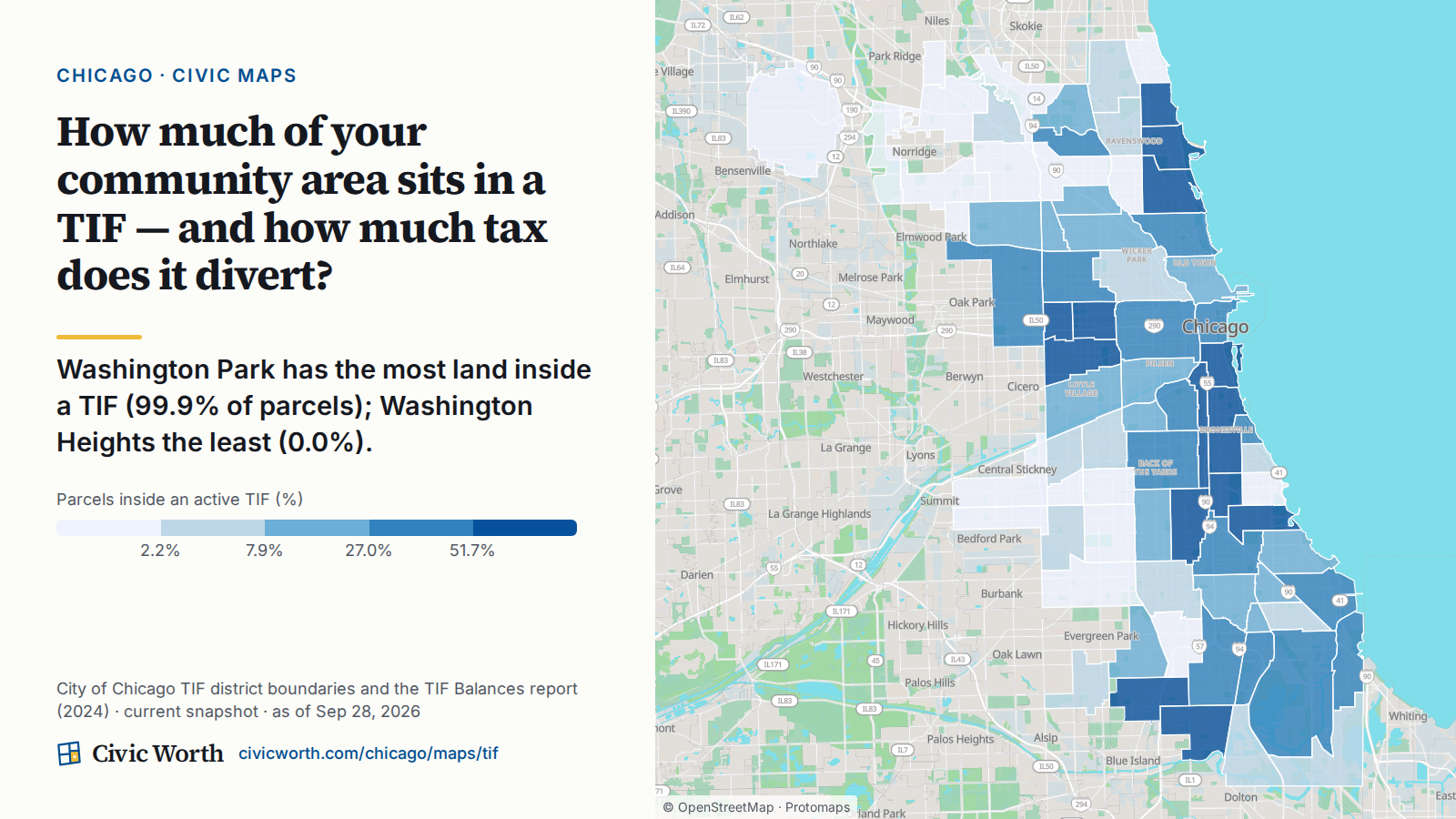
That's the question Civic Worth's Chicago TIF map answers, and the finding as of October 3, 2026 is a wide spread: Washington Park has the highest share of parcels inside an active TIF, 99.9%; Washington Heights is one of five community areas at 0.0%. Source: City of Chicago TIF district boundaries and the TIF Balances report (2024).
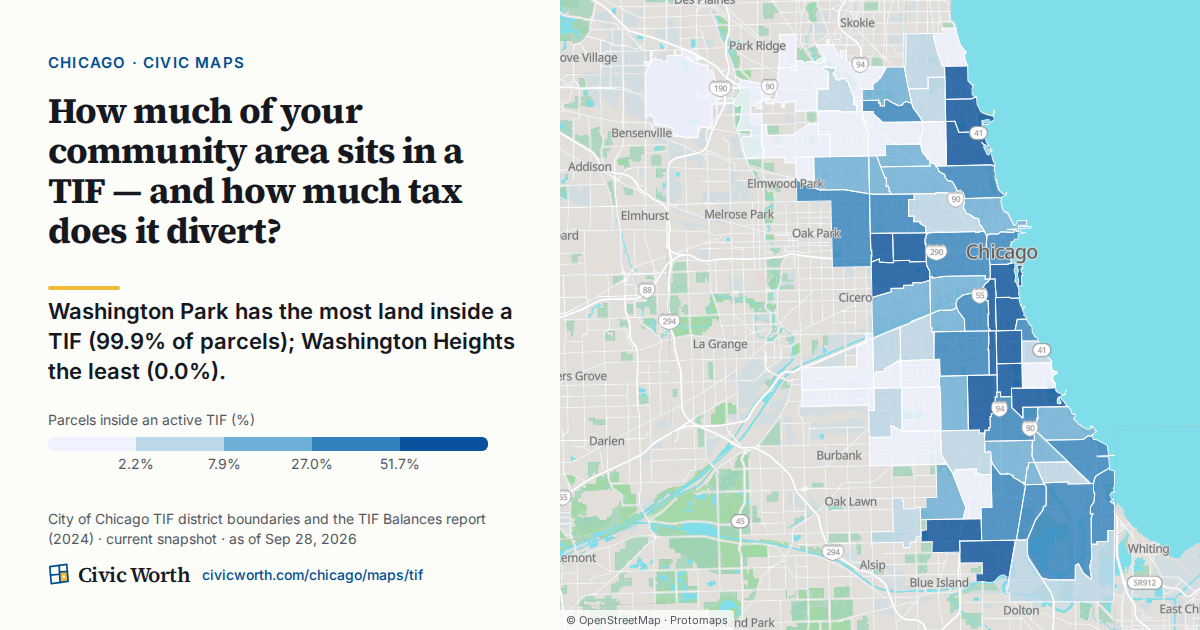
Read that gap again. By the City's boundary file, nearly all of Washington Park lies inside active TIF districts, mostly the Washington Park TIF, approved in 2014 and set to expire at the end of 2038, with most of the rest in the 47th/State TIF (City of Chicago, TIF district boundaries). In Washington Heights, the City lists the 95th & Western TIF as touching the community area, but its boundary meets it only along the edge, and the map counts none of its parcels inside. That's the difference between "most of the value growth here goes to a TIF" and "almost none of it does."
You can look up your own community area on the Chicago TIF map and see where it falls between those poles. A second view, increment per parcel, estimates the scale of the diverted revenue. It takes each district's most recent annual increment from the 2024 TIF Balances report and splits it across the community areas the district covers by their share of its parcels. The City reports increment per district, not per parcel, so read it as the scale for an area, not an exact figure.
What it does to your tax bill
Your bill is your property's taxable value (its equalized assessed value, or EAV) times the combined rates of all the taxing districts that serve it, "regardless of whether your property is in a TIF district or not. The difference the TIF makes is where your tax dollars are going" (Cook County Clerk, 2024 TIF Report). There is no tax rate for the TIF itself (Cook County Clerk, TIF FAQs), and property inside a TIF is taxed at the same rates as other property in its taxing districts (65 ILCS 5/11-74.4-9(c)).
The effect reaches past the TIF line. The other taxing districts can only tax the frozen value inside the TIF when their rates are calculated, so their levies are spread over less value, which makes their rates higher for every property they serve, inside the TIF or not (Cook County Clerk, 2024 TIF Report). If your property is in a TIF, the district is listed in the Municipality/Township Taxes section of your tax bill (Cook County Clerk, 2024 TIF Report).
For scale, the Clerk puts Chicago TIF revenue at $1.59 billion for tax year 2024, 17.8% of all the tax billed for the taxing districts in the city (Cook County Clerk, 2024 TIF Report).
How long it lasts, and the exceptions
A Chicago TIF generally runs 23 years (City of Chicago, Tax Increment Financing Program). When it ends, "the increase in revenue over the base amount is distributed annually among the seven taxing bodies in the city that are based on property values" (City of Chicago, Tax Increment Financing Program).
Three things soften the trade before then. A city can declare a TIF surplus, which the Cook County Treasurer distributes to the affected taxing districts. Chicago's two Transit TIFs pay CPS its share of the increment first, then send 80% of the rest to the TIF and 20% to the other taxing districts. And a city can use TIF funds for capital projects of schools and other taxing districts through intergovernmental agreements (Cook County Clerk, 2024 TIF Report; 65 ILCS 5/11-74.4-8). State law also lets a city move TIF revenue to an adjoining TIF district (65 ILCS 5/11-74.4-4(q)).
Why the community-area number isn't the whole story
A TIF boundary doesn't follow a neighborhood name. The City's file lists the Washington Park TIF in seven community areas (City of Chicago, TIF district boundaries). And the Clerk tracks a TIF parcel by parcel, setting the frozen base for each lot, block, tract or parcel in it (65 ILCS 5/11-74.4-9). So a community area's share, even 99.9%, describes the area, not your address.
To check one property, use the official records: your tax bill lists a TIF in its Municipality/Township Taxes section, and the Clerk's TIF Viewer searches by PIN or address (Cook County Clerk). If you need your PIN first, see what a 14-digit PIN knows about your property.
Civic Worth's map places each parcel by testing its center point against the City's boundaries. Checked against the Cook County Assessor's own TIF field on a sample of about 2,600 parcels, the two agreed about 91% of the time; most differences were parcels near a district edge or ones the Assessor's field leaves blank. Use the map for the pattern and the bill or the TIF Viewer for one address.
How to use this if you're a reporter or a nonprofit
Covering a development story or a budget hearing, or writing a grant narrative? You can pull the TIF share for a community area from the map, cite the City of Chicago TIF boundaries and the TIF Balances report by name, and give the as-of date. The underlying records are public without a FOIA request: the City publishes its TIF boundaries on its data portal and each district's annual report on its TIF pages, and the Clerk publishes a TIF report every year (City of Chicago; Cook County Clerk).
If your story also touches on how fast the City resolves service requests in a TIF-heavy area, the Chicago 311 response-time map covers that separately. If the TIF sits near a zoning question, Civic Worth's Chicago address lookup shows the parcel's zoning district. And Civic Worth's list of Chicago TIF districts names the wards and community areas each one covers; for how those two geographies differ, see community areas vs. wards.
What this map does and doesn't tell you
The map shows two things: the share of a community area's parcels inside an active TIF, and an estimate of the increment per parcel. It does not explain why a particular boundary was drawn where it was, and it does not predict what will get built or when. Its color ramp is neutral; in the map's own words, "TIF is a contested tool, and this map reports magnitude, not a verdict." Whether Washington Park or Washington Heights is better or worse off for its TIF status is a judgment for residents, officials and reporters.
What the map can do is put the baseline fact in front of you, with its source and date. Everything else, the politics, the project list, the payback period, builds on top of that fact. It shouldn't substitute for it.
Look up your own community area
Pull up the Chicago TIF map and find your community area. See where it lands next to Washington Park's 99.9% and Washington Heights' 0.0%, then switch to the increment view for the estimated scale. For a single address, confirm it on the tax bill or the Clerk's TIF Viewer before you cite it.
Sources
- 65 ILCS 5/11-74.4-8, Tax increment allocation financing (Illinois General Assembly)
- 65 ILCS 5/11-74.4-9, Equalized assessed value of property
- 65 ILCS 5/11-74.4-4, Municipal powers and duties (including 4(q))
- Cook County Clerk, 2024 TIF Report (released January 21, 2026)
- Cook County Clerk, TIFs 101
- Cook County Clerk, TIF FAQs
- Cook County Clerk, TIF Viewer
- City of Chicago, Department of Planning and Development, Tax Increment Financing Program
- City of Chicago, TIF District Annual Reports
- City of Chicago Data Portal, Boundaries - Tax Increment Financing Districts
- City of Chicago Data Portal, Boundaries - Community Areas
Frequently asked
How does tax increment financing work in Chicago?
When a TIF is created, the Cook County Clerk freezes a base value for each parcel in it, the "initial equalized assessed value." Each year, the tax on any value above that base, the "increment," goes to the district's special tax allocation fund to pay redevelopment project costs, and the tax on the base goes to the other taxing districts (65 ILCS 5/11-74.4-8, 11-74.4-9). In Chicago a TIF generally runs 23 years (City of Chicago, Tax Increment Financing Program).
How much of my community area is inside a TIF district?
Civic Worth's TIF map shows the share of each community area's parcels inside an active TIF, from City of Chicago TIF boundaries: as of October 3, 2026, from 99.9% in Washington Park to 0.0% in Washington Heights and four other community areas. To check a single address, look for a TIF in the Municipality/Township Taxes section of your tax bill, or search your PIN or address on the Cook County Clerk's TIF Viewer (Cook County Clerk, 2024 TIF Report).
Does a TIF district affect funding for schools and parks?
Yes. Chicago Public Schools, the Chicago Park District and the other taxing bodies get no new revenue from value growth inside a TIF while it runs; they can tax only the frozen base there, so their levies are spread over less value (Cook County Clerk, TIFs 101 and 2024 TIF Report). There are exceptions: Chicago's two Transit TIFs pay CPS its share first, a city can declare a surplus that goes back to the taxing districts, and TIF funds can pay for school and park capital projects through intergovernmental agreements (Cook County Clerk, 2024 TIF Report).