What Your Block's 311 Record Can and Can't Tell You
· Updated
The City of Columbus publishes the 311 requests opened in the last 30 days, each with its location, type, assigned department and status. Here's how to read that record for your block, and what it doesn't record.
Correction (October 3, 2026): An earlier version of this article said a block's open 311 requests show where the City is paying attention and deploying resources. The City's 311 data records each request's location, type, assigned department and status, not where resources go, and in that data how quickly requests close differs far more by type of request than by council district (City of Columbus, 311 Service Requests Last 30 Days, as of October 3, 2026).
What the City publishes about your block
The City of Columbus publishes its 311 data as a map layer called "311 Service Requests Last 30 Days." The City's help guide for its 311 map says: "The map is updated every morning to display service requests opened in the previous 30 days. Requests for bulk trash pickup are not shown on the map." You can search that map for an address or a parcel (City of Columbus, 311 Service Request Map Help Guide).
Each record in the layer can carry:
- the request's category, subcategory and type, such as "Pothole On City Street" or "Code/Weeds or High Grass on Property";
- the City department, division, section and team it was assigned to;
- the date it was reported, its current status and a status date;
- a street address or intersection, a ZIP code and map coordinates (on most records);
- the Columbus Communities planning area, area commission and council district it falls in.
The published fields don't include the name of the person who made the report, and they don't include a parcel number (City of Columbus, 311 Service Requests Last 30 Days).
Read the status, not just "open"
On October 3, 2026, the City's layer held 30,038 records. "Closed" was one of eight statuses:
| Status | Records |
|---|---|
| Closed | 20,445 |
| Received | 5,048 |
| In Progress | 2,576 |
| Canceled | 1,365 |
| Written Orders Issued | 424 |
| Work Order In Progress | 146 |
| Re-Assigned | 32 |
| Returned | 2 |
Canceled is its own status, separate from Closed. "Written Orders Issued" belongs almost entirely to code cases: 396 of those 424 records were assigned to Building and Zoning's Code Enforcement division, and the rest to the Department of Health. For housing code violations, the City Code says a notice of violation must "allow a reasonable time for the performance of any act it requires" (C.C. 4509.02).
Not every record is a complaint: 9,360 records had a request type ending in "Information/Notes." All of them were assigned to the Department of Neighborhoods, and 9,355 were already Closed.
Compare like with like
How quickly a request closes differs a lot by type. We took the requests in the City's October 3 data that were reported from September 3 to September 26, 2026, so each had had at least seven days, and counted the share marked Closed within seven days of being reported:
- missed recycling (Public Service): 98%
- pothole on a City street (Public Service, Street Maintenance): 81%
- fallen tree or limb (Recreation and Parks, Forestry): 68%
- weeds or high grass on a property (Building and Zoning, Code Enforcement): 29%
- street-light repair (Public Utilities, Electricity): 11%
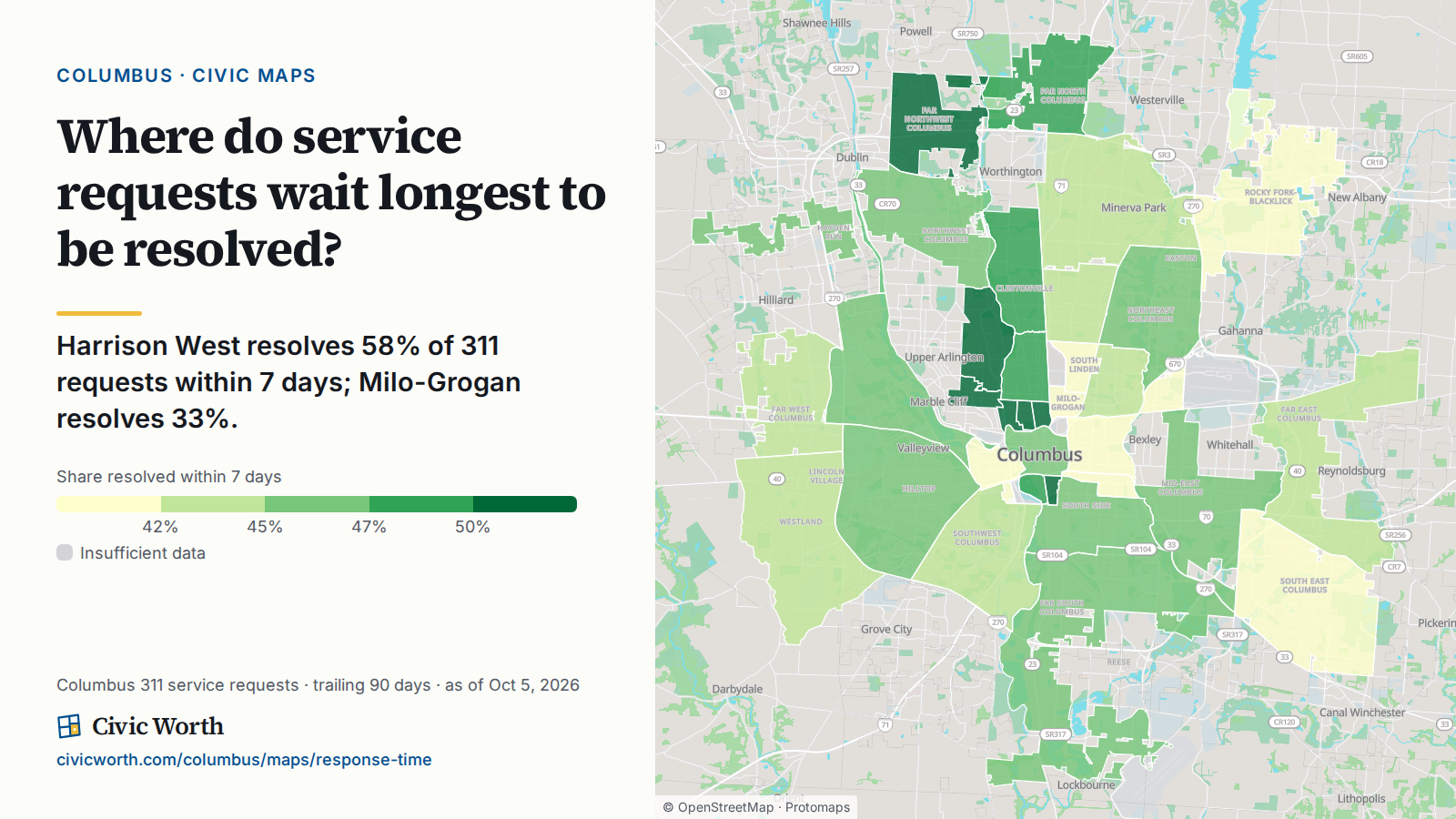
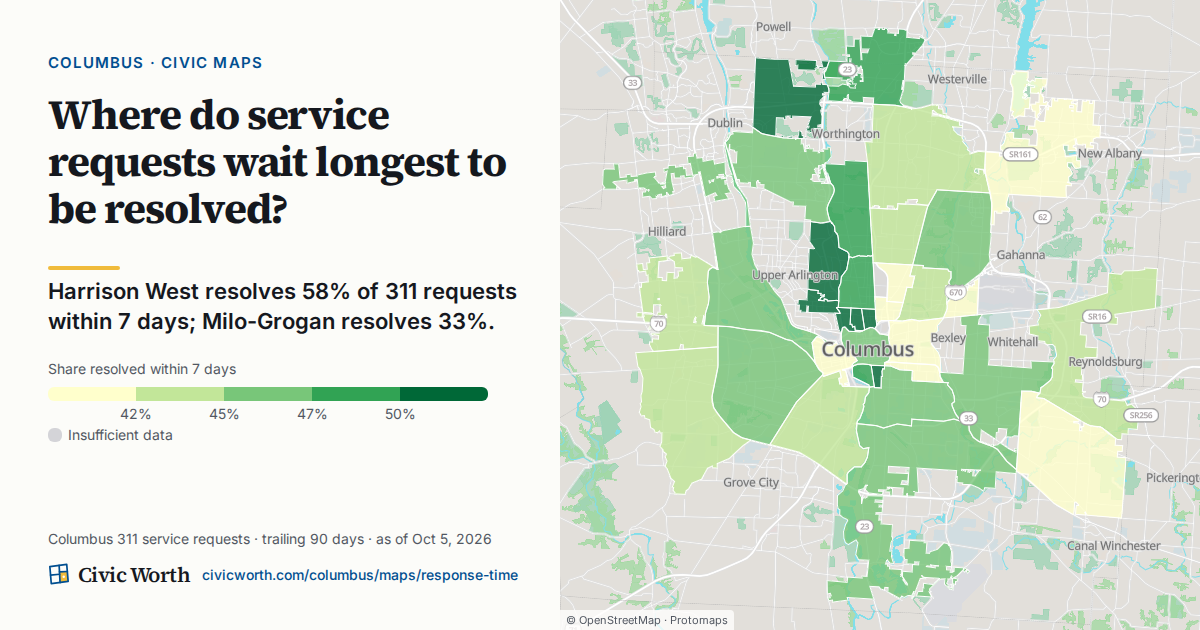
Across the nine council districts, the same measure ranged only from 46% to 55%. This is our count from the City's data, not a City statistic, and it covers only the few weeks the City publishes at a time. It describes what closed; it doesn't say why.
The City does publish its own figure for one type. Its pothole page says a report is forwarded to the Street Maintenance Section "for scheduling and filling," with "an average of over 90% being filled within 3 days of being reported" (City of Columbus, Report a Pothole). That measures filling; our count measures when the 311 record was marked Closed.
So before reading anything into an open request on your block, compare it with requests of the same type. Why a 311 request can take a while goes further.
What the record can't tell you
Nothing in the record measures staffing, spending or where crews are sent. A status and two dates tell you what stage a request reached, not why it's there.
The City's map also won't show a request from last spring. To check an older request, use the City's Look Up 311 Request page with the request or case number: "No login required: Access the status of any 311 request or cases."
A ZIP code is also a poor unit for this. In the City's October 3 data, the 1,533 requests in ZIP 43206 fell in council Districts 7 and 8; in the Columbus South Side and Livingston Avenue area commissions, plus some with no area commission listed; and in four Columbus Communities planning areas.
Using it in a story or a grant
Cite what the record shows: what was reported, where, its type, the department it went to, and its status as of a date. A line like "a pothole request at this intersection, reported September 10, assigned to Street Maintenance, Closed as of September 12" can be checked against the City's data. A claim about how much attention the City gives a block can't, because the record doesn't measure attention.
For a step-by-step lookup, see how to check 311 requests for your Columbus address. Civic Worth's free address preview lists 311 requests within 200 m of an address over the last 30 days (up to 25), each with its source and an as-of date. Search an address at civicworth.com.
Sources
- City of Columbus, 311 Service Requests Last 30 Days (queried October 3, 2026)
- City of Columbus, 311 Service Request Map Help Guide and the 311 Service Request Map
- City of Columbus, Look Up 311 Request
- City of Columbus, Report a Pothole
- Columbus City Code, Chapter 4509: Enforcement; Notice; Penalties
Frequently asked
What does the City's 311 record show about my block?
Each request's type, the City department and division it was assigned to, the date it was reported, its status and status date, and for most requests a street address or intersection with map coordinates (City of Columbus, 311 Service Requests Last 30 Days). The City's 311 map shows service requests opened in the previous 30 days, except bulk trash pickups (City of Columbus, 311 Service Request Map Help Guide).
Does an open 311 request mean the City is ignoring my block?
The record doesn't say. It shows a status, not a reason. Of the requests reported September 3 to 26, 2026, in the City's 311 data as of October 3, the share Closed within seven days ranged from 11% for street-light repair to 98% for missed recycling, but only from 46% to 55% across the nine council districts (our count from City of Columbus, 311 Service Requests Last 30 Days). Compare an open request with others of the same type.
How do I check a 311 request that's older than 30 days?
Enter its request or case number on the City's Look Up 311 Request page; the City says no login is required. With a 311 account you can also get status updates by email (City of Columbus, Look Up 311 Request; 311 Account Services).