Why Is My Columbus 311 Request Taking So Long? How to Check Where It Stands
· Updated
A Columbus 311 request's record shows which City department has it and what stage it's at, but not why it's taking as long as it is. Here's how to check yours, and how requests of the same type compare in the City's own data.
Correction (October 3, 2026): An earlier version of this article said how fast a 311 request closes depends mainly on your council district and area commission, which it described as separate jurisdictions. Columbus has one City Council whose members are each elected from one of nine districts (City Charter Sec. 4), area commissions are advisory bodies (C.C. 3109.14), and in the City's own 311 data closure speed differs far more by type of request than by council district (City of Columbus, 311 Service Requests Last 30 Days, as of October 3, 2026).
The short answer: the record shows where it is, not why
Every request in the City's published 311 data records its type and the City department it was assigned to, and nearly all name a division too. In the 30 days of requests the City published on October 3, 2026, each of the 323 request types went to a single department (City of Columbus, 311 Service Requests Last 30 Days).
The record also shows the request's status and dates. It doesn't record why a request is taking as long as it is. For that, a City statement is the source. For most request types we didn't find one. The pothole page is an exception: a report is forwarded to the Street Maintenance Section "for scheduling and filling," and the City says "an average of over 90%" are filled "within 3 days of being reported" (City of Columbus, Report a Pothole).
How requests of the same type compare
We took the requests in the City's October 3 data that were reported from September 3 to September 26, 2026, so each had had at least seven days, and counted the share marked Closed within seven days of being reported. By type, with the City department (and division) each went to:
- missed recycling (Public Service): 98%
- pothole on a City street (Public Service, Street Maintenance): 81%
- fallen tree or limb (Recreation and Parks, Forestry): 68%
- weeds or high grass on a property (Building and Zoning, Code Enforcement): 29%
- street-light repair (Public Utilities, Electricity): 11%
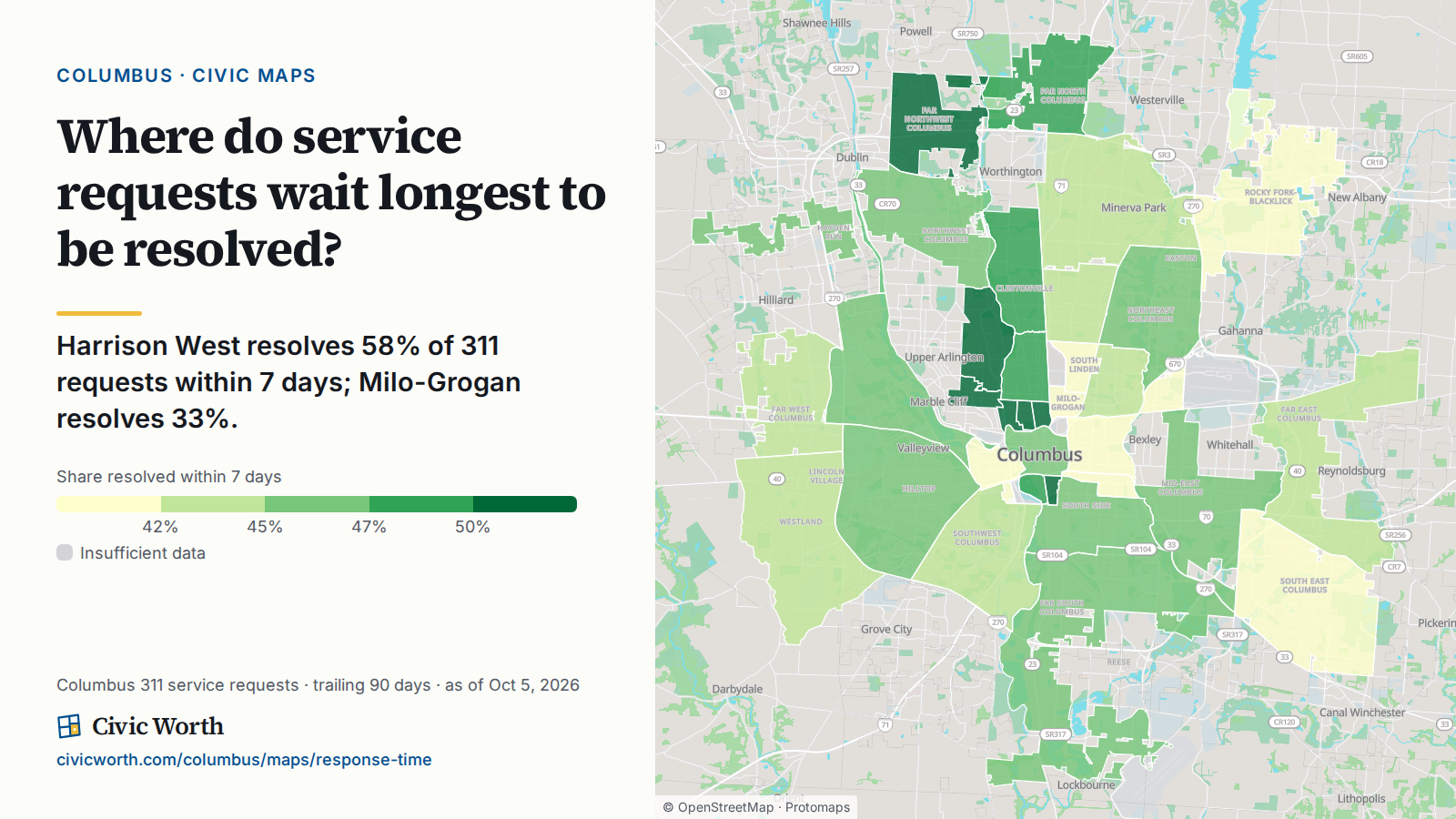
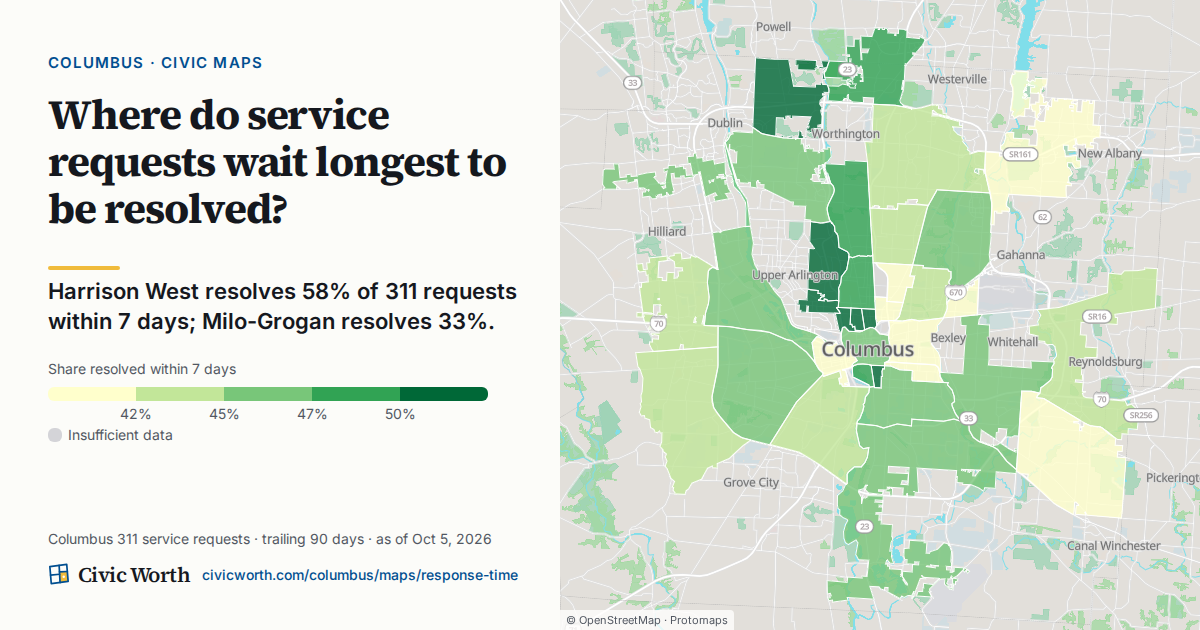
Across the nine council districts, the same measure ranged only from 46% to 55%.
This is our count from the City's data, not a City statistic. The City publishes only requests opened in the previous 30 days (City of Columbus, 311 Service Request Map Help Guide), so it covers a few weeks, and it says nothing about why one type closes faster than another. What it does suggest is the fairest comparison for your request: other requests of the same type.
What the status tells you
In the City's October 3 data, requests had one of eight statuses: Received, In Progress, Work Order In Progress, Written Orders Issued, Re-Assigned, Returned, Canceled and Closed.
- Written Orders Issued (424 records) was almost all code cases: 396 were assigned to Building and Zoning's Code Enforcement division, the rest to the Department of Health. For housing code violations, the City Code says a notice of violation must "allow a reasonable time for the performance of any act it requires" (C.C. 4509.02).
- Work Order In Progress (146) was almost all Recreation and Parks' Forestry division (143).
- Canceled (1,365) is a separate status from Closed, and Re-Assigned (32) is its own status too.
How to check your own request
- By number. The City's Look Up 311 Request page takes a service request or case number. The City says: "No login required: Access the status of any 311 request or cases."
- With an account. "With an account, you can login for status updates as well as receive email updates," and the CBUS 311 app can send push notifications. For requests created before April 9, 2022, the City says to call (614) 645-3111 or email [email protected] (City of Columbus, 311 Account Services).
- By address. The City's 311 Service Request Map searches by address or parcel and shows the last 30 days, except bulk trash pickups.
Where your council district and area commission fit
The City's data tags each request with its council district, area commission and Columbus Communities planning area. That lets you compare the same request type across districts, rather than all requests at once.
Each member of Columbus City Council "shall be elected from one of nine districts by the electors of the city" (City Charter Sec. 4). An area commission "is an advisory body," and its duties include to "Recommend priorities for and review government services and operation of the various government departments in the commission area" (C.C. 3109.14). So a run of same-type requests near you is something you can bring to your council office or your area commission. Not every address has an area commission: the City's Board of Zoning Adjustment application points to the City's ONE Map "for areas not served by" an area commission. What is my area commission? shows how to find yours.
What the data can't tell you
Staffing, priorities and crew schedules aren't in the record. To ask about a specific request, contact the 311 Customer Service Center at (614) 645-3111 or [email protected].
Civic Worth's free address preview lists 311 requests within 200 m of an address over the last 30 days (up to 25), each with its source and an as-of date, and the response-time map compares neighborhoods. For what a block's 311 record can show, see what your block's 311 record can and can't tell you.
Sources
- City of Columbus, 311 Service Requests Last 30 Days (queried October 3, 2026)
- City of Columbus, 311 Service Request Map Help Guide and the 311 Service Request Map
- City of Columbus, Look Up 311 Request and 311 Account Services
- City of Columbus, Report a Pothole
- Columbus City Code, Chapter 4509: Enforcement; Notice; Penalties
- Columbus City Code, Chapter 3109: Area Commissions
- Columbus City Charter, The Council (Sec. 4)
- City of Columbus, Board of Zoning Adjustment Application (2026)
Frequently asked
Why is my 311 request taking so long?
The City's 311 record shows your request's type, the department it was assigned to and its status, but not the reason for a wait. Types differ a lot: of requests reported September 3 to 26, 2026, 98% of missed-recycling requests were Closed within seven days, against 11% of street-light repairs (our count from City of Columbus, 311 Service Requests Last 30 Days, as of October 3, 2026). For potholes, the City says over 90% are filled within 3 days on average (City of Columbus, Report a Pothole).
Does my council district or area commission affect how fast it's handled?
The City's data doesn't show a cause. It does show that, for requests reported September 3 to 26, 2026, the share Closed within seven days ranged only from 46% to 55% across the nine council districts, against 11% to 98% across common request types (our count from City of Columbus, 311 Service Requests Last 30 Days). Each request is assigned to a City department, and area commissions are advisory bodies (C.C. 3109.14).
How do I check my 311 request's status?
Enter its service request or case number on the City's Look Up 311 Request page; the City says no login is required. With a 311 account you can also get email updates, and push notifications in the CBUS 311 app (City of Columbus, Look Up 311 Request; 311 Account Services).