What Area Commissions Are Actually For (It's Not Stopping Development)
Area commissions can't veto development, they force early public disclosure of decisions developers have already made. This piece explains the real mechanism and what residents should demand before the vote, not after.
What area commissions actually do (and don't)
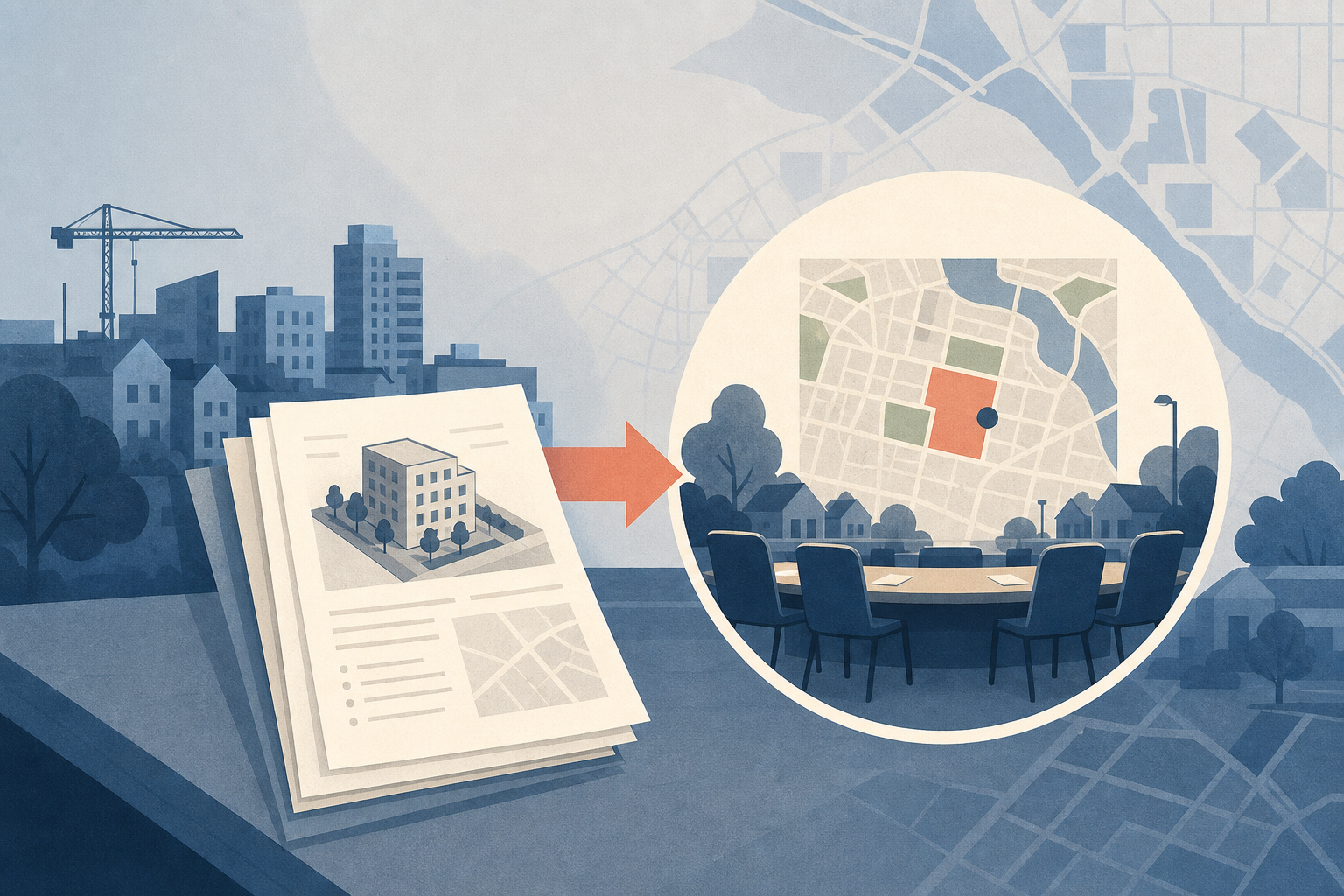
Here's the misconception, stated plainly so we can retire it: an area commission is not a body that stops bad development. It cannot veto a variance. It cannot kill a project it dislikes. What it can do, and does do, is force a developer's plans into public view before Columbus City Council or the Board of Zoning Adjustment (BZA) makes the real decision.
That's it. That's the mechanism. An area commission issues a recommendation, advisory in most cases, and that recommendation goes into the record that Council or the BZA considers. Sometimes commissions carry more procedural weight for specific case types than others, which is exactly why "is this recommendation binding?" is a question worth asking out loud at the meeting rather than assuming the answer.
Once you stop expecting a stop sign and start seeing the transparency mechanism for what it is, the whole process gets a lot less confusing, and a lot more useful.
Why this distinction actually matters to you
If you think the commission can block the project, you show up to object. If you understand the commission can only recommend, you show up to shape conditions, ask precise questions, and get things on the record early enough for them to matter. Same meeting. Completely different strategy, and a completely different outcome for the residents who understand which one they're actually in.
By the time the meeting happens, most of the decision is already made
This is the part that catches people off guard, and it shouldn't, once you think about how development actually works. By the time a project reaches an area commission agenda, the developer has typically already:
- Settled the site plan
- Decided which variances they need and why
- Lined up financing, or gotten close enough to it that walking away isn't really on the table
The commission meeting is the public's first look at the plan. It is very rarely the negotiating table, no matter how much it might feel like one when the room is packed and people are lined up at the mic. We've written before about why the city already knows about a zoning variance before your commission does, and the short version is: staff review and developer conversations happen well upstream of the public meeting. Residents who treat commission night as their only input point have already missed the window where their input could reshape anything.
What to demand before the vote, not after
So what actually works? Three specific things, and none of them require a law degree.
The exact variance, and the code section it falls under
"They want a variance" tells you nothing actionable. "They're requesting a setback variance under this specific zoning code section" tells you exactly what rule is being bent and why. Vague objections get ignored. Specific, code-anchored questions get answered, and sometimes negotiated.
The parcel's zoning history, old versus new
Was the parcel zoned commercial and now being rezoned residential? Was there a prior variance on this same lot that nobody remembers? Zoning history tells you whether this request is a small technical adjustment or a fundamental change in what the parcel is allowed to be. This is precisely what Civic Worth's Zone In Decoder is built to lay out: old zoning against proposed zoning, for that specific parcel, not a ZIP-code approximation of the neighborhood around it.
Whether this recommendation is binding or advisory, for this case
Don't assume. Ask it directly, on the record, at the meeting. The answer changes how much weight your testimony actually carries downstream, and it's a fair question for any commission member to answer plainly.
And before any of that: you need to know which area commission and ward your address even falls under, because commission boundaries and council districts don't always line up the way people assume. That's the starting point, and it's covered in council district versus area commission.
A reactive resident versus a prepared one
Picture two versions of the same meeting.
The reactive resident finds out about the project from a yard sign or a neighbor's text the week of the meeting. They show up, they're upset, they say so. The commission listens politely. The vote happens roughly as planned, because the objection arrived after the plan was locked and carried no specific, code-anchored ask.
The prepared resident pulls the parcel's zoning history and 311 history in advance. They show up with the exact code section in hand, ask whether the recommendation is binding for this case type, and propose a specific condition, maybe a landscaping buffer, maybe a traffic mitigation ask, tied to something the zoning code actually allows the commission to weigh in on. That resident's condition sometimes ends up in the recommendation before it's even drafted, because it was concrete enough for staff and commissioners to act on.
Same process. Same commission. Wildly different leverage, because one person showed up with parcel-level facts and the other showed up with a feeling.
Why this matters for reporters and nonprofits especially
If you cover development or do place-based advocacy, this pattern is your beat, whether or not anyone's called it that. Zoning history is public record. So is 311 history for a given address. So is which area commission a parcel sits in. But all of it is scattered across dozens of separate city, county, and state records systems, filed under different formats and different update schedules, which is exactly why so few residents (and honestly, more than a few reporters) ever pull it before the meeting instead of after.
Joining those sources at the parcel level, not the ZIP code, is what makes it possible to walk into a commission meeting with the right question instead of a general complaint. That's the whole premise behind checking 311 requests for a Columbus address as a companion move to zoning history: pattern plus history equals a real question.
Columbus newsrooms and 501(c)(3) nonprofits get about 100 free reports a month specifically because this kind of reporting and advocacy work depends on parcel-accurate context, not a ZIP-level guess. If your outlet or organization covers land use regularly, that access is worth using before your next commission cycle, not after a project's already been approved.
Explore the full Zone In tool to see how old-versus-new zoning gets laid out for any Columbus parcel.
Look up your address before the next meeting
You don't need to wait for a yard sign to find out what's coming. Start with the free address preview at Civic Worth, pull your council district, your area commission, and your parcel's zoning history, and walk into your next meeting already knowing the question worth asking.
Frequently asked
Can a Columbus area commission stop a development or deny a variance?
No. Area commissions make advisory recommendations to Columbus City Council or the Board of Zoning Adjustment, who hold the actual decision-making power. A commission can vote against a project, and that vote carries real weight as a public record, but it doesn't legally block anything on its own.
What should I ask at an area commission meeting before the vote happens?
Ask for the exact variance requested and the code section it falls under, the parcel's current zoning versus what's proposed, and whether the commission's recommendation is binding or advisory for that specific case. Those three questions surface most of what actually shapes the outcome.
Is an area commission recommendation binding on City Council?
It depends on the case type and sometimes the specific commission's standing agreement with the city, so don't assume. Ask the question directly at the meeting. Treating every recommendation as automatically binding, or automatically ignorable, are both mistakes residents make.