Three pre-written story summaries
Each is roughly 200 words and citation-ready. Paste, edit, or expand — CC-BY-4.0 with a backlink to civicworth.com.
Ohio has until Sept 28 to pick its next decade of Opportunity Zones — 1,032 tracts qualify, at most 258 make the cut
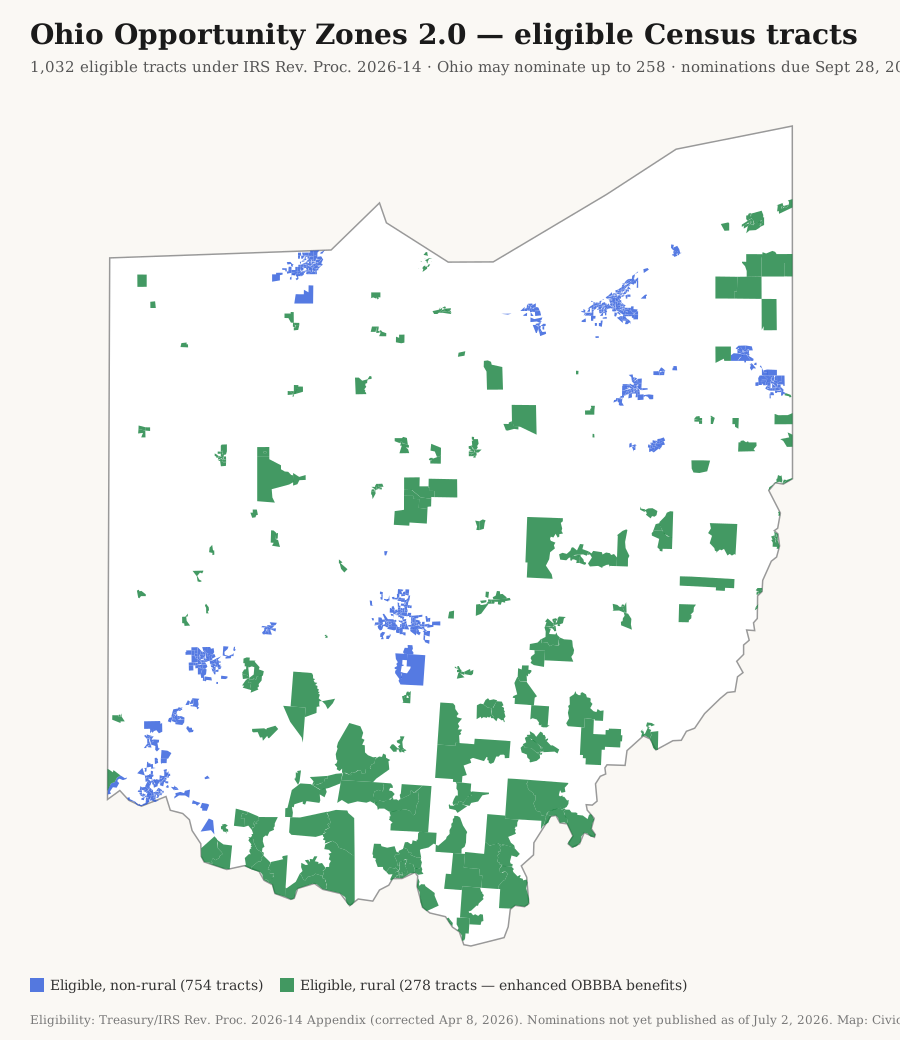
Under the One Big Beautiful Bill Act signed July 4, 2025, the federal Opportunity Zone program became permanent — and the first new designation round is happening now. The IRS published the eligible-tract list in April 2026 (Rev. Proc. 2026-14): census tracts qualify if median family income is at or below 70% of the area median, or if the poverty rate is at least 20% with income no higher than 125% of area median. That is a tighter test than the 2018 round — the old 80% threshold is gone, and so is the "contiguous tract" loophole. In Ohio, 1,032 of the state’s 3,168 tracts qualify. Federal law caps the governor’s nominations at 25% of eligible tracts — 258 for Ohio, fewer than the 320 zones the state designated in 2018. The Ohio Department of Development collected local nominations through July 10; the governor’s list is due to the U.S. Treasury by September 28, 2026, and the new zones take effect January 1, 2027, running through 2036. Existing 2018-cycle zones sunset December 31, 2028. Any Ohio address can be checked against the eligible list at civicworth.com/micro-investment.
What Opportunity Zones 2.0 means for Columbus: 132 Franklin County tracts are eligible; 43 current zones expire in 2028
Franklin County has 132 census tracts on the new federal Opportunity Zone eligible list — second only to Cuyahoga County’s 185 — concentrated in the same neighborhoods the 2018 round touched: Franklinton, the Near East Side, Linden, the Hilltop, and the South Side. Forty-three Franklin County tracts were designated Qualified Opportunity Zones in 2018; under the new law those designations sunset on December 31, 2028, so investors and community groups face a genuine transition question, not a renewal formality. The new eligibility test is stricter than 2018’s (70% of area median family income, down from 80%), and eligibility is no guarantee of designation: Ohio may nominate at most 258 of its 1,032 eligible tracts statewide, and the governor’s list — due to the U.S. Treasury by September 28, 2026 — has not been published. A designated tract offers investors capital-gains deferral and, for investments held ten years, exclusion of appreciation, which is why designation decisions draw both development interest and displacement concern. Civic Worth’s free tract pages (civicworth.com/micro-investment) show any parcel’s eligibility status, the income data behind it, and the 2017-cycle comparison, with citations to the Treasury and IRS source files.
The quiet change in Opportunity Zones 2.0: rural Ohio tracts get better terms than cities for the first time
Of Ohio’s 1,032 census tracts eligible for the new Opportunity Zone round, 278 are classified rural — and for the first time, rural designation carries materially better investment terms. The One Big Beautiful Bill Act created "qualified rural opportunity funds" whose investors receive a 30% basis step-up (versus 10% standard) and face a substantial-improvement threshold cut in half, for investments made after December 31, 2026. Treasury’s companion guidance (IRS Notice 2025-50) also classified 3,309 of the existing 2018-cycle zones nationwide as rural, extending the enhanced terms to them — 92 of Ohio’s 320 current zones qualify. A rural area is defined as anything outside a city or town of more than 50,000 people and its adjacent urbanized area. The rural share matters for the nomination math: Ohio’s governor may nominate at most 258 tracts statewide by September 28, 2026, and every rural tract nominated brings the enhanced federal terms with it. Civic Worth’s tract lookup (civicworth.com/micro-investment) shows each tract’s rural classification alongside the income data that qualified it.
Embeddable tract widget
Drop a live tract-status card (map + both designation cycles + the statutory timeline) into an article. Replace TRACT_GEOID with an 11-digit Census tract GEOID — readers can find any address’s tract at civicworth.com. The widget updates automatically if the tract's status changes during the window.
<iframe
  src="https://civicworth.com/embed/micro-investment/TRACT_GEOID?cw_src=newsroom"
  width="100%"
  height="720"
  loading="lazy"
  sandbox="allow-scripts allow-same-origin allow-popups"
  title="Civic Worth Opportunity Zone tract widget"
></iframe>
Live example — Franklin County tract 39049000310 →